What Apple Teaches Software Companies About Pricing Power
Every year, a new price announcement, the same headline: "How does Apple get away with it?"
It’s no secret the tech giant charges 30% to 40% more than their competitors for functionally similar products. They upsell devices with features other companies include in their base model. They increase prices for materials and design details that don’t really cost much more to produce. All the while, millions of people wait in line to buy the latest device every year.
If you're a software company struggling to maintain pricing power while competitors undercut you, Apple's playbook can teach you something.
The Architecture of Apple's Pricing Power
Apple's pricing power doesn't come from innovation alone. Plenty of companies innovate. Apple's pricing power comes from creating a systemic competitive advantage that makes customers willing to pay premium prices. Their strategy is held up by four pillars:
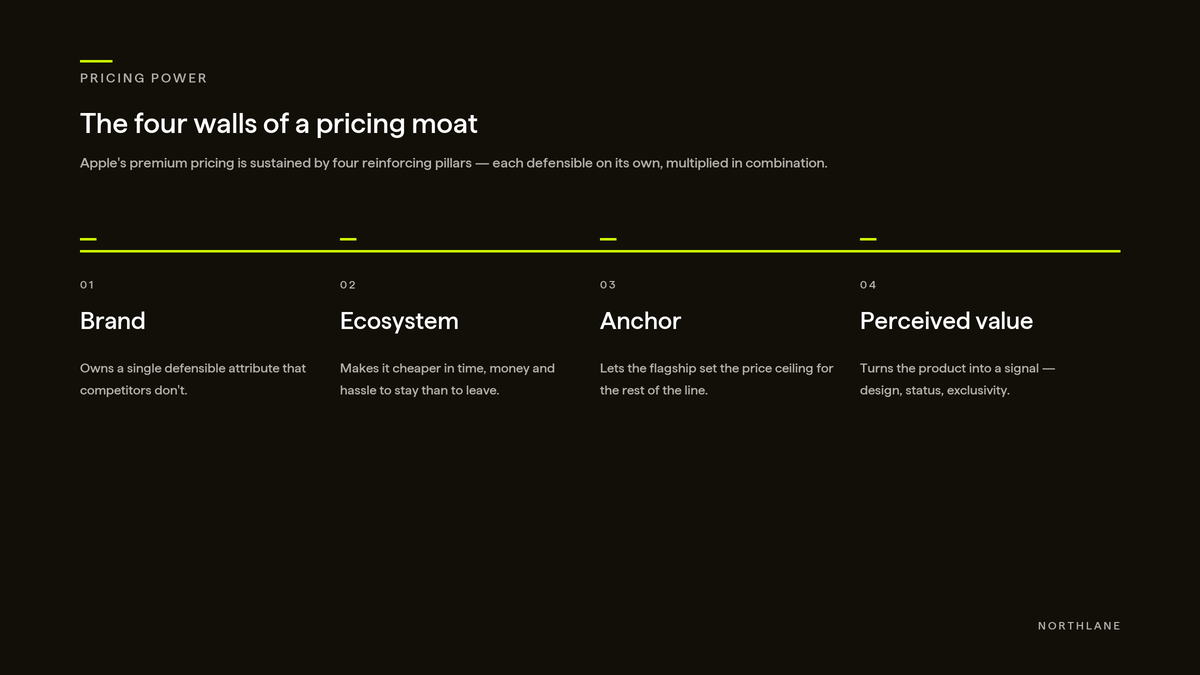
1. Brand as a Byword for Quality
Apple spent decades building a cohesive and recognizable brand that signals premium quality and status.
In essence, Apple doesn't sell phones. It sells membership into a club that values design, simplicity, and innovation. The phone is the artifact; the brand is the asset.
When a customer sees "Apple," they don't think "device with a fast processor." They think "quality," "design," "it just works." This brand signal is so strong that Apple can charge 40% more than Samsung for a phone with similar specs, and customers willingly pay the premium.
How software companies can apply this:
You don't need to spend two decades building a brand, but you do need to be relentless about one thing: associating your brand with a specific, highly valued attribute that competitors don't own.
Here are some examples of software companies that have done this:
- Superhuman: Associated with speed and elite status for power users. It’s not an "email client," but "email for the ambitious."
- Figma: Associated with collaboration and design accessibility. It’s not a "design tool," but "where designers and teams build together."
- Notion: Associated with flexibility and customization. It’s not a "note-taking app," but "an operating system for your brain."
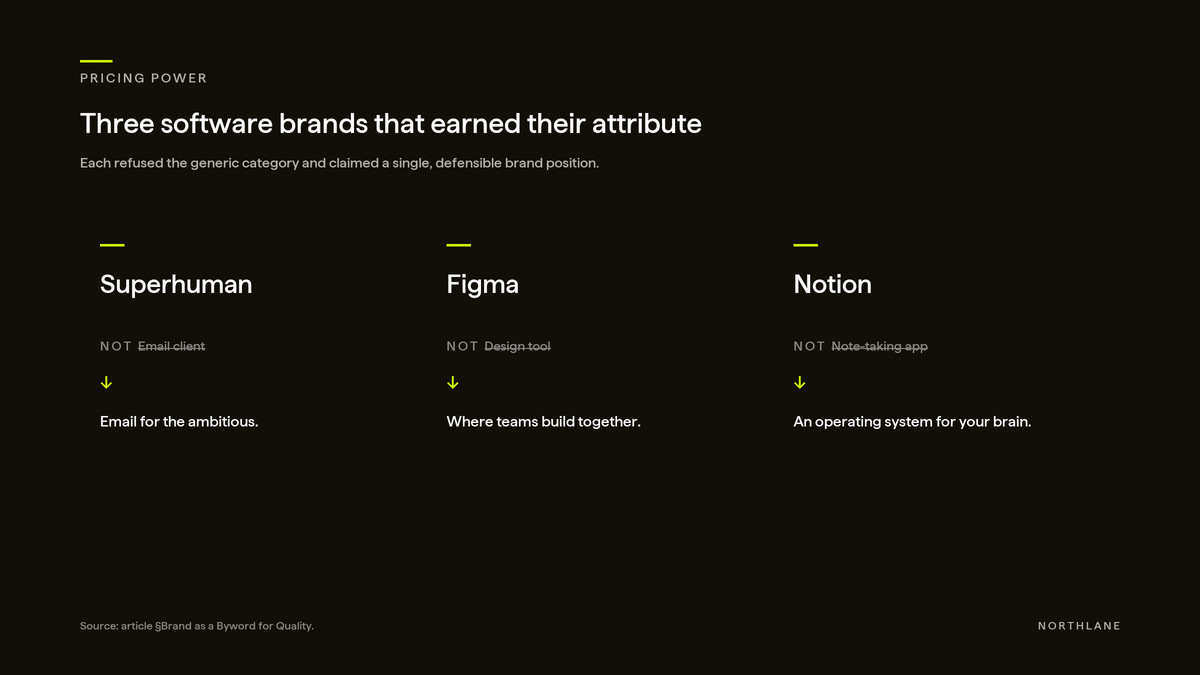
These brands aren't accidents. They're enforced through consistent messaging, product design, and community. And they're incredibly valuable for pricing—because when someone chooses Notion, for example, they're not just buying a tool. They're buying the brand signal that comes with it.
2. Ecosystem Lock-In (Make It Easier to Stay Than Leave)
Apple's killer move is making it cheaper (in time, money, and hassle) to stay within their ecosystem than to leave.
Buy an iPhone, and suddenly your Mac makes more sense. Buy a Mac, and AirPods become the natural choice. Buy AirPods, and the watch adds more value. You're not locked in by contract. You're locked in by convenience.
This has a mathematical effect on pricing power. Customers are less price-sensitive when switching costs are high—whether they pay in time, money, or a compatibility hassle. You can raise prices without customers churning.
How software companies can apply this:
Most B2B software companies think about lock-in only through contracts or technical switching costs, but Apple's lock-in is behavioral and psychological.
Consider how to make your product more valuable when customers use multiple products from your suite:
- Native integrations between products: Notion's integration between docs, databases, and wikis is seamless. Leaving Notion means losing that integration.
- Data and context portability within the ecosystem: Slack holds all your conversation history and integrations. Switching means reconstructing all of that.
- Shared identity and permissions: Once you've set up an entire team in Figma, switching means rebuilding permissions and design systems.
The companies with the highest pricing power are the ones where the value of the ecosystem is greater than the sum of the parts.
3. Anchor Pricing (The Flagship Sets the Price Ceiling)
Apple’s pricing architecture is grounded deep in pricing psychology. It relies on the research that shows anchoring heavily shapes how customers perceive value.¹
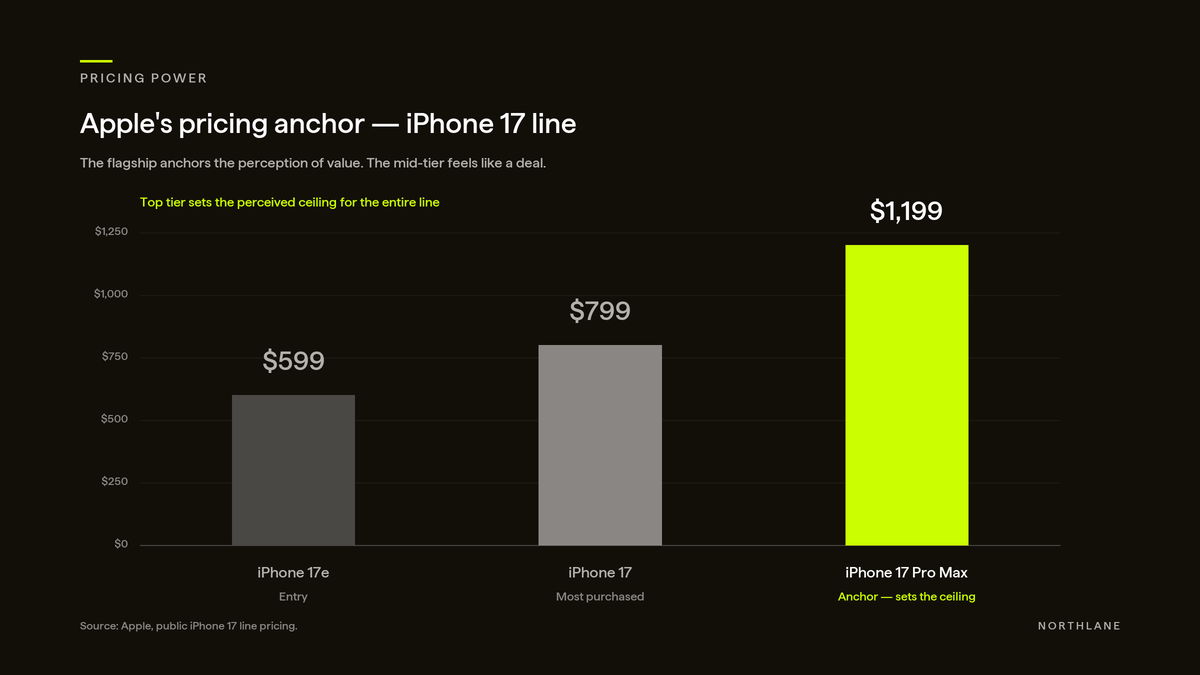
The base-level iPhone 17 Pro Max costs $1,199. The base-level iPhone 17 costs $799. The base-level iPhone 17e costs $599. Most customers buy the standard iPhone, but the Pro Max's existence raises the perceived value of the standard phone. You feel like you're getting a great deal.
This is anchor pricing. The flagship product anchors the perception of value for the entire line. It makes a $799 phone feel reasonable instead of expensive. Apple also employs the decoy effect—introducing middle options that make premium tiers appear more attractive by comparison. This is a psychological principle where adding a less-attractive option increases preference for the premium option.²
How software companies can apply this:
Most SaaS companies price in reverse—a free tier at the bottom, then a starter tier, a growth tier, and an Enterprise tier. This creates a different psychology: "The free tier is good enough, so why pay?"
Apple reverses this. The most powerful (and most expensive) option anchors the tier above it.
Use a pricing architecture that works:
- Price the most capable tier first: Make your Enterprise/Custom tier your strategic anchor. Price it at the value it creates. This is the tier that drives perception of value for everything else.
- Use an anchor to drive behaviour: If you want to incentivize more expensive plans, anchor based on your price per unit and let volume discounts speak. If you want to drive people towards adoption of cheaper tiers, make sure there are premium tiers to make them look better value.
- Give options: Even in a sales environment, avoid giving a single quote - it loads the negotiation in the prospect’s favor. Instead, bracket your preferred option with a slightly overpriced lower option, and an expensive premium option, to drive customers to it naturally.
4. Perceived Value (Style, Status, and Signaling)
Here's the thing about Apple's pricing power that no one talks about—a lot of it comes from people wanting to be seen using an Apple product.
An iPhone 17 does what a Pixel 10 does. The difference is an iPhone signals something about the owner that a Pixel doesn't (in certain circles, anyway). You're paying for the perception that you're intentional, thoughtful, and someone who values design.
This is status signaling, and it's a massive component of Apple's pricing power that most software companies ignore.
How software companies can apply this:
Not every software product can be a status symbol, but the ones that do become status symbols have dramatically higher pricing power. For example:
- Claude: Higher Claude spend / usage is now seen as a badge of honour.
- Superhuman: Using Superhuman signals that you're efficient and technologically adept.
You can build perceived value with:
- Limited access or exclusive community: Superhuman originally had a waiting list. That scarcity created perception of value.
- Association with admirable companies or people: When respected people use your product visibly, it signals quality.
- Attention to aesthetic detail: Design matters. A beautifully designed product signals quality. Compare the Figma interface to most competitors, and the design itself is a signal.
- Transparent exclusion: Making it clear who your product is for (and implicitly, who it's not for) creates status signaling.
What This Means for Your Pricing
If you're competing in software and feeling price pressure, the answer isn't to discount. It's to build your own ecosystem:
1. Own a brand attribute: You should have something that matters to customers, but isn’t something offered by your competitors (whether it’s a feature, a look, or an ideology).
2. Build ecosystem lock-in: Make your product more valuable in combination with other products you offer. You want it to be more valuable to stay than it is to leave.
3. Architect your pricing tiers: The top tier anchors the perception of value for everything else.
4. Invest in perceived value: This could be design quality, community exclusivity, or a signal of status—anything that justifies premium pricing.
None of this requires being a major player like Apple. It requires being deliberate about positioning and pricing in alignment with your actual strengths.
The software companies with the most pricing power aren't the ones with the best features or highest end products. They're the ones with the clearest positioning, the strongest brand signals, and the most thoughtful pricing architecture.
Sustainable pricing power is one of the strongest competitive advantages any company can have. It’s worth investing in building it from day one.

Written by
Nick Zarb