Channel and Partner Pricing: How Software Companies Leave Money on the Table

Most software companies sell directly to customers. Some sell through channels like resellers, integrators, marketplaces, distribution partners.
Channel pricing is often seen as an afterthought, just a discount off list price with some extra margin layered in for the partner. They’re surprised when economics don't work in their favor or their direct sales team is undercut by their own partners.
The truth is that channel pricing is a commercial discipline completely in its own lane. When a company gets it right, it opens up major growth opportunities that most teams overlook. Here’s what you need to know.
The Channel Economics Problem
When you sell direct, you set a price and the customer pays it. Revenue is predictable. Margin is clear. When you sell through a channel, it's more complex:
- Your list price creates your gross revenue potential
- The partner takes a margin (usually 10-30+%)
- What remains after partner margin is your net revenue
- Out of that, you need to fund channel support, marketing, and enablement
Here’s a simple example:
List price: $10k/year
Partner margin: 30%
Your net revenue: $7k/year
Channel overhead (marketing, support, training): ~$1k/year
Your operating revenue: ~$6k/year
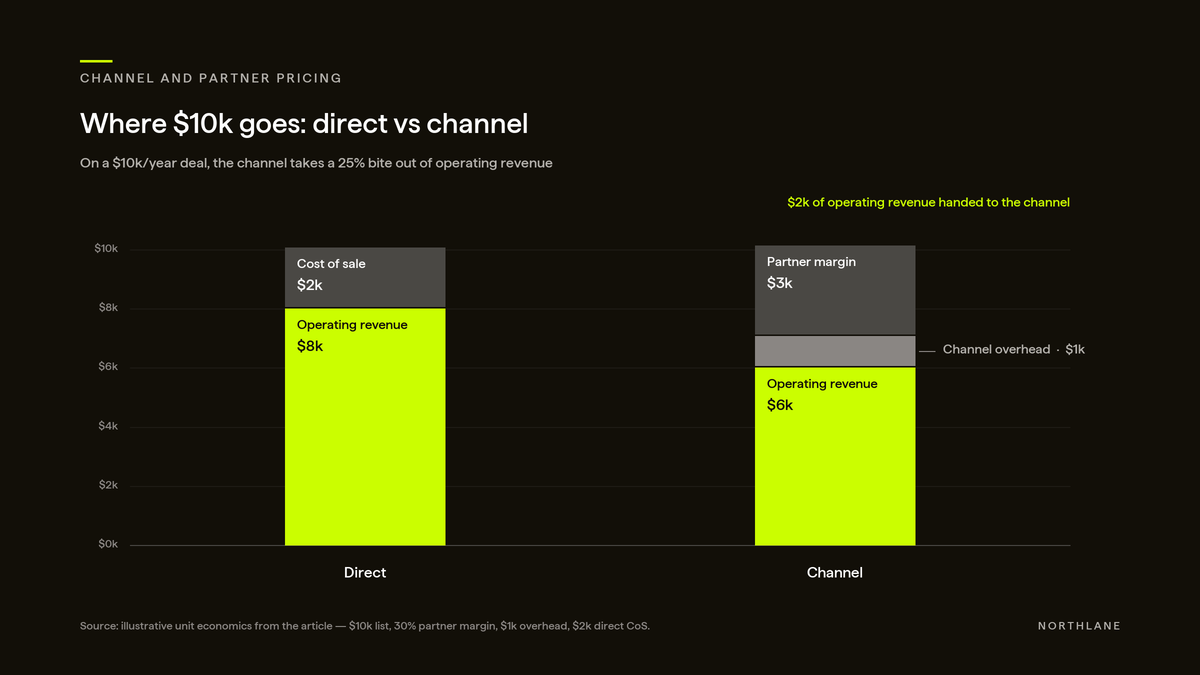
Compare that to direct:
List price: $10k/year
Direct sales cost of sale: ~$2k/year
Your operating revenue: ~$8k/year
In other words, the channel deal needs to be larger, the margin needs to be smaller, or the partner needs to be more efficient for the channel to make economic sense.
This is where most companies get it wrong. They set channel margins without understanding the unit economics. Then, they’re surprised when the channel isn't profitable.
The Three Tiers of Channel
Different types of partners need different economics. There are three main types.
1. Direct Resellers / Solution Integrators
Direct resellers are companies that implement your product as part of their service delivery. They embed it in solutions for their customers. This includes Solution Integrators (SI’s), System Integrators, and Service Partners.
Typical economics:
- List price: $10k/year
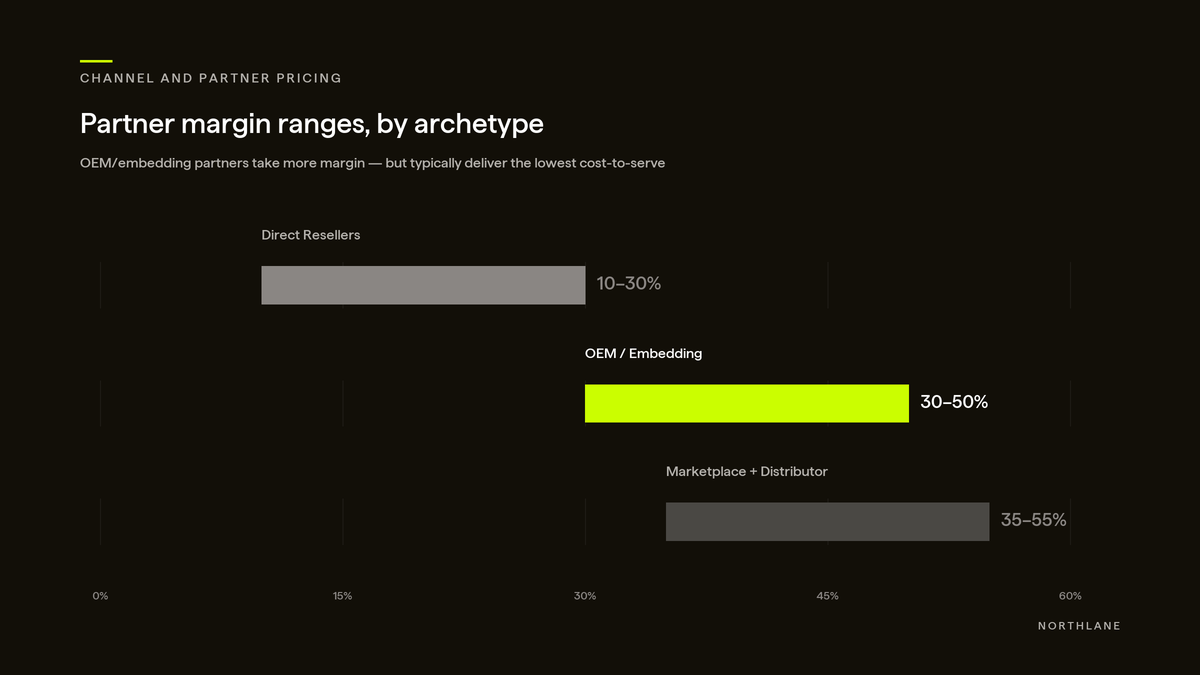
- Reseller margin: 10–30%
- System integrator margin: 20–40%
- Your net: $6–8k/year
Why this margin?
- Resellers bring implementation, support, and customer success
- They reduce your support burden
- They build solutions that create stickiness
- Switching costs are higher (client is embedded with the SI)
When it works:
- You have minimal marketing spend to drive the deal (the SI does that)
- You have streamlined deal registration, so the SI gets protected deals
- You have good partner portals and documentation
2. OEM and Embedding Partners
These are companies that embed your technology into their product. They don't resell you. They white-label or embed you.
Typical economics:
- List price: Not applicable (you're usually on a per-unit or per-usage model)
- OEM margin: 30–50% (sometimes higher for scale partners)
- Your net: 50–70% of the per-unit value
Why this (higher) margin?
- They drive volume
- They reduce your customer acquisition cost to nearly zero
- They handle their own support and implementation
- The deal is very sticky (embedded in their product)
When it works:
OEM and embedding partners are an all-around good channel for software companies. These deals are usually the most profitable for you overall—even with the high margin. This is because:
- Customer acquisition cost is zero
- Support burden is low
- Churn is low (they have to switch products to leave)
However, there’s a real closeness and dependency to an OEM relationship that often means it’s scary - it requires a strong, trusted partner and sustainable mutual interest to bear fruit and avoid adverse consequences like cannibalizing your core product.
3. Marketplace and Distribution
Marketplaces (Salesforce AppExchange, AWS Marketplace, etc.) and distributors take a bigger cut because they're handling discovery, transactions, and sometimes billing.
Typical economics:
- List price: $10k/year
- Marketplace fee: 20–30%
- Distributor markup: Another 15–25%
- Your net: $5–6.5k/year
The dynamics:
Marketplaces drive discovery and credibility, while distributors handle logistics and billing. Your net margin is thin, but you're often not doing the sales, implementation, or support.
When it works:
- You're targeting smaller deals (SMB, not enterprise)
- Your product has self-service implementation
- Your addressable market is broad (thousands of potential customers, not dozens)
The Channel Conflict Problem
You must have a competitive margin to retain your channel partners. Nonetheless, it's only part of the equation.
Here's where it gets complicated: you probably have direct sales AND channels. When you have both, you create channel conflict:
- Direct sales and resellers are competing for the same deal
- Resellers undercut each other because they don't see each other's deals
- Your direct team gets frustrated with resellers who don't deliver
The solution is deal registration, a systematic way to claim deals. Deal registration works like this:
1. A reseller identifies an opportunity
2. They register it with you (customer name, rough deal size)
3. Once registered, the deal is "protected" and direct sales can't touch it
4. If it's a deal that direct could get on their own, they compete fairly
Rules matter. To prevent conflict, keep an eye on:
- Registration windows: Deals need to be registered before a certain point. This can be the first contact, qualification, or whatever you define.
- Protection period: Once registered, how long is the deal protected? 90–180 days is the norm.
- Enforcement: If a deal is registered and direct tries to take it, there should be a conflict resolution process
- Value threshold: Which deals get protected? Some companies say "only deals above $X" or "only specific customer segments.”
Good deal registration eliminates channel conflict. Bad deal registration (or no deal registration) creates mutual distrust.
Pricing Strategies for Different Channel Models
You approach each type of channel model with a different pricing strategy.
Direct Resellers
Introduce tiered pricing programs that reward partners for commitment and performance.
Here’s an example:
- List price: $10k/year
- Tier 1 pricing: $7k/year (30% margin) at $0–$500k annual sales
- Tier 2 pricing: $6.5k/year (35% margin) at $500k–$2M annual sales
- Tier 3 pricing: $6k/year (40% margin) at $2M+ annual sales
This incentivizes:
- Resellers to sell more (they receive a volume bonus)
- Resellers to build solutions that stick (higher retention = more recurring)
- You to scale your reseller base
Embedded / OEM
Price incentive: Per-unit or per-usage with scale-based margin.
Here’s an example:
Per-customer pricing: $100/year per customer on the reseller's platform
Reseller margin structure:
- 0–1,000 units: 35%
- 1,000–5,000 units: 40%
- 5,000+ units: 45%
This incentivizes:
- Growth (more customers = better margin)
- Low implementation friction (margins go up as they scale)
- Mutual expansion
Marketplace
Price incentive: Usually fixed (you don't control the margin—the marketplace does).
Cloud marketplaces vary significantly in their fee structures. AWS Marketplace charges 1.5–3% vendor fees (the lowest among major platforms), while Azure Marketplace operates variable fee models, and app stores like Salesforce AppExchange and Microsoft AppSource charge 15–30% platform fees.⁴
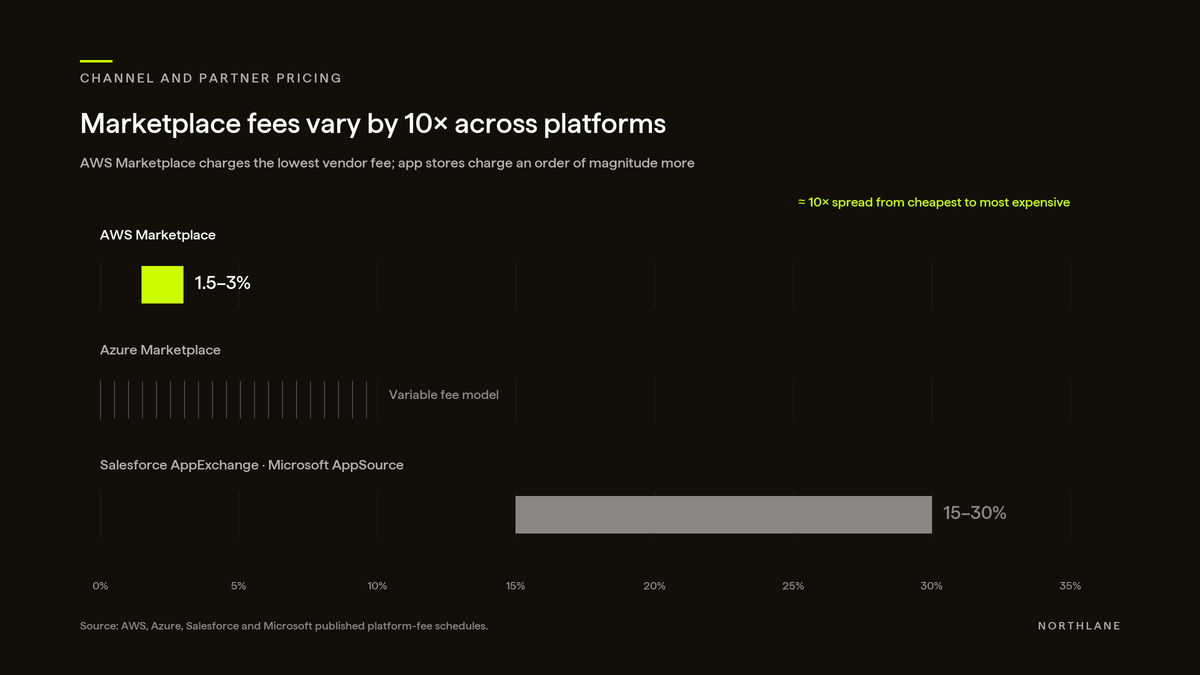
Your marketplace pricing needs to account for these deductions, so price higher on the marketplace to account for the marketplace fee.
Here’s an example:
- Direct pricing: $10k/year
- Marketplace pricing: $13k/year (to net the same $10k after marketplace fee)
This type of marketplace pricing works when:
- The marketplace brings customers you wouldn't otherwise get
- The marketplace charges a flat fee (not a percentage)
- You have pricing flexibility
The Partner Margin Trap
Many software companies make the same common mistake when setting channel pricing—they set their partner margins before they understand their unit economics. Things like “our resellers take 30% margin" becomes a rule, applied across all partner types.
But channel pricing isn’t a one-size fits all solution. A reseller for enterprise deals (where you’re doing the majority of the selling and ongoing support) is different from a reseller for SMB deals (which usually handles the whole pipeline). The economics simply aren’t the same.
Instead, use a more nuanced approach:
- Define the partner type (reseller, OEM, marketplace, etc.)
- Understand their economics (cost to serve, support burden, acquisition cost)
- Set margin based on economics, not tradition
- Review and adjust quarterly (Is this profitable for both parties?)
Marketplace Pricing Strategy
Pricing on marketplaces deserves special attention because the dynamics are different.
Most people place low prices on marketplace to help you get discovered, win trials, and prove value. Unfortunately, low prices train customers to expect that price forever. When they scale, they don't want to pay premium pricing, or if they speak to you directly, they might be in for a nasty sticker shock that damages the relationship.
Instead, use one of these marketplace strategies:
- Entry tier only on marketplace: Your lowest-price tier is the only one available on marketplace. Customers who grow will need to upgrade to your direct pricing.
- Contract terms on marketplace: Limit discounts by requiring annual upfront payment. This reduces support burden and improves unit economics.
- Marketplace-specific feature restrictions: Limit what's available on marketplace. For example, only offer advanced features through direct sales.
Partner Enablement and Pricing Education
Most channel breakdowns happen because partners don't understand your pricing strategy. One of the most important elements of channel pricing strategy is clear, consistent communication.
Real enablement includes:
- Clear margin structure: Partners should know exactly how much they make at different deal sizes
- Packaging explanation: Understand the why behind your tiers. For example, why is this feature in the Professional tier? What should they position at which level?
- Competitive positioning: Partners should understand how to position you against competitors. What's your value prop?
- Deal registration process: You should outline clear rules about claiming deals
- Pricing guardrails: Partners need to understand what they can discount and what they can't change.
Partners who understand this sell better and are less likely to create channel conflict.

The Common Mistakes
Here are the six most common mistakes software companies make when pricing for partners and channels.
1. Not differentiating channel economics by partner type: one margin fits all does not work
2. Setting margins without understanding unit economics: you’ll have a pretty margin on paper, that’s unprofitable in reality
3. No deal registration system: this causes channel conflict and distrust
4. Expecting partners to sell at list price: they won't, so your pricing gets undercut
5. Ignoring marketplace pricing: marketplace is a different ecosystem than direct
6. No partner enablement: partners need to understand how to sell your pricing
Building Your Channel Strategy
Build a solid channel strategy with three phases—whether you're starting with new channels or revamping pricing on old channels:
Phase 1:
- Define partner types (reseller, OEM, marketplace, etc.)
- Calculate unit economics for each type
- Set margin that works for both parties
- Create basic deal registration rules
Phase 2:
- Create a partner pricing guide (clear margin structure, packaging explanation)
- Implement deal registration workflow (protected deals)
- Train sales and partners on channel strategy
Phase 3:
- Monitor channel profitability and adjust
- Build partner self-service portal
- Implement tiered margins based on volume performance
The Upside
Companies that get channel pricing right unlock significant growth:
- A $10M direct ARR company might add $2-3M through channels (depending on market)
- OEM partnerships especially can be high-margin and low-effort once set up
- Resellers extend your reach into markets you couldn't serve directly
But this only works if the economics make sense for both parties.

Written by
James Wood