A conversation with Michelle Coventry (Creandum)
"We should have made this a podcast"
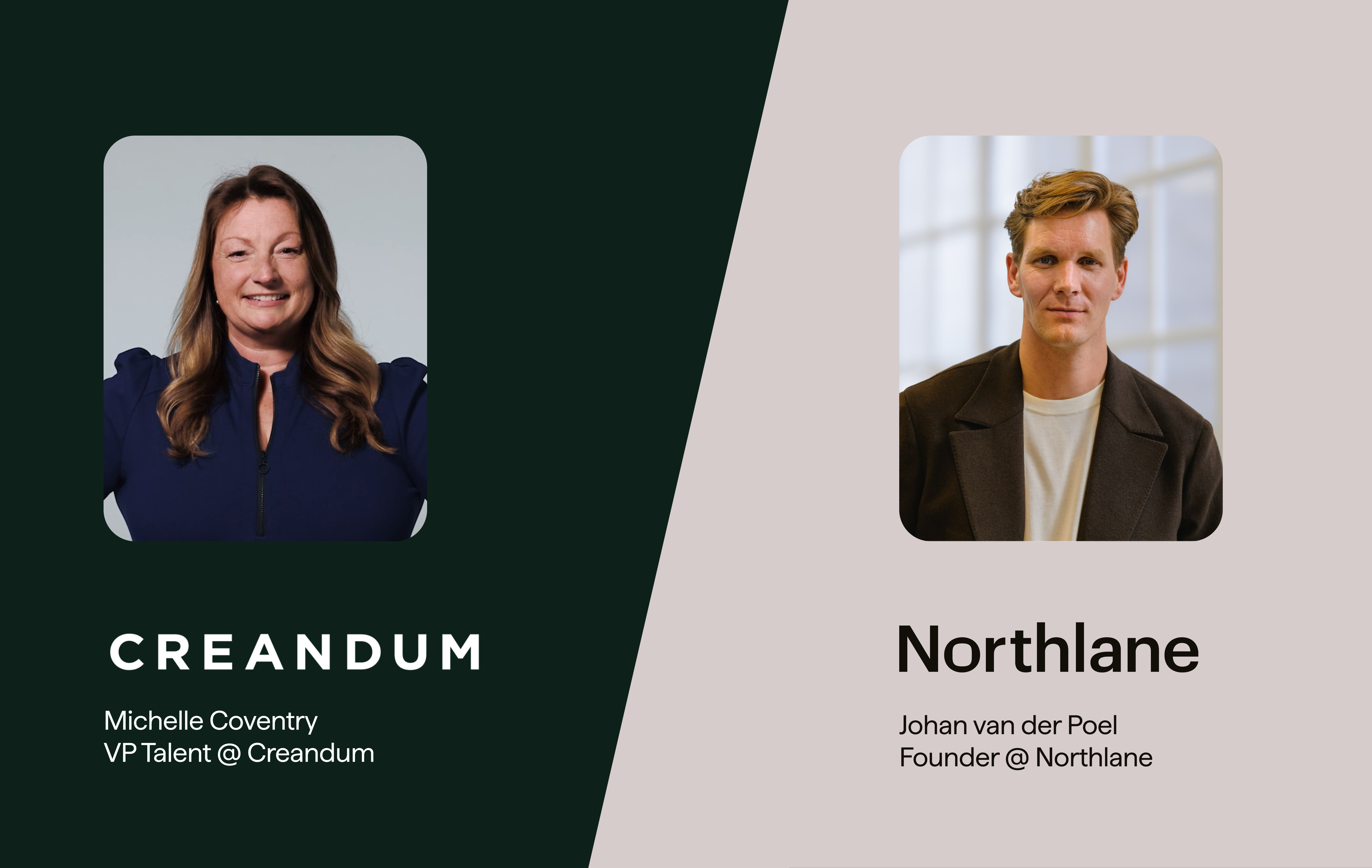
A conversation with Michelle Coventry (Creandum) on the AI portfolio divide, the future of consulting, and what it takes to build something world-class right now
Some conversations you wish you'd hit record on. This was one of them. Halfway through a catch-up call to plan a session for Creandum's portfolio, Michelle Coventry and I looked at each other and said the same thing — we should have made this a podcast. So we've done the next best thing and written it up.
What follows is a lightly edited version of that conversation: a venture investor and a strategy consultant comparing notes on what AI is actually doing to companies, careers, and the craft of building. — Johan van der Poel, Northlane
Johan: It feels like we haven't stopped saying "this is crazy" for two years. Every week there's something new. We're rebuilding what strategy consulting even is — on a topic where we already had the credibility and the flywheel. Every week it's, this is insane, in the best way.
Michelle: It's been a crazy few months here too. I genuinely can't explain how it feels, every minute seems accounted for. But it keeps me bright and on my toes, the fact that we're learning this fast. We've got such a range of companies now, it's remarkable. Some of our most recent deals are in areas we'd not invested in before.
Johan: Let's talk about that range, because you see it across a whole portfolio.
Michelle: That's what surprised me most. I've been at Creandum for five years. Some of the companies we had the most conviction about early on struggled to find market fit — or they had fit, the market shifted, and suddenly they didn't. It's been choppy. And then the ones where you quietly wondered, are they ever going to get there? — some of them are breaking through now, stronger than expected, as the market finally caught up to them. Timing is everything. You watch a founder who's been grinding for years, and it all comes together at once. That's part of the magic of this job — the believing.
Johan: And the other side of that coin?
Michelle: The other side is harder. Some longer-tenured companies we were genuinely excited about now face real pressure from AI-first competitors. It's digital transformation and change management, essentially — happening to companies that need to adopt and adjust to stay ahead. The challenge isn't unique to any one of them; it's the era.
Johan: That really resonates. I was talking with an investor recently who's started classifying their whole portfolio into roughly three groups, and it's almost the same picture. You've got the very large companies, where doing something on AI is often closer to marketing than to a real change — they need the story, but they're hard to turn quickly. Then a middle cohort, where the growth trajectory just isn't where it needs to be, and they have to pivot or rebuild. And then the AI-native group.
Michelle: And the irony is that the most recent group's advantage is that they have nothing to unlearn.
Johan: Exactly. Having no legacy turns out to be a gift. They can start from a clean sheet and define the new playbook, and the trajectories are extraordinary — growing the way the best software businesses used to, at one or two years old.
Michelle: We've actually started measuring this. Some research I did earlier in the year turned into an internal tool for measuring AI fluency across our companies, which we've now released to the wider ecosystem, so we can see how deep it really goes. And what you find are two broad camps: AI-empowered (the ones transitioning) and AI-native. But even "AI-native" is a continuum, with companies in different places along the spectrum.
Johan: It's completely a spectrum, for sure.
Michelle: Even the standout companies. In one fast-growing team I looked at, the headcount in their people function was far higher than anywhere else in the business, simply because it's a race, so you put people on the challenge. But in every other function, they're astonishingly lean. That contrast is the whole story right now.
Johan: The leadership angle is where this gets very real for founders, though.
Michelle: It's the sharp end of everything. We've seen founders reach a point of real honesty with themselves, recognizing the company needs a different kind of leadership for this next chapter than the one that got it here today. And when you go looking for that next leader, you realize the old scorecard doesn't fit anymore.
There is a human instinct to assume the AI shift is incremental. It isn't. A company can be quietly losing ground while everyone assumes things are fine yet you're being jack-knifed by AI-first competition popping through. So when you're hiring for that next lead in any function, you have to be clear that it may be the most important hire the company will ever make. And you often have to rebuild the criteria from scratch to get it right.
Johan: That's the thing people don't say clearly enough: in a lot of these businesses, the change has to come from the very top. You can't delegate your way through it.
Michelle: It all comes from the top. Which is also why, if I'm going to tell our companies that change starts with leadership, we have to hold ourselves to exactly the same standard internally in the fund.
Johan: Completely. We try to apply that to ourselves too — using these tools on our own processes, like hiring, so we build a clear, consistent record of how we evaluate and decide. If you believe in it, you have to live it.
Michelle: Here's my honest tension, though. The anxiety has dropped, I'll give it that. And yet I'm still at 120%. There was a promise that all this would power you up so much that it would hand you back time. We just seem to have filled the time even more with new developments to learn.
Johan: I never quite believed that promise, and here's why: it's still a competition. So you do more in the same time. In consulting, our projects still take roughly six to eight weeks — about the same as before. But the difference is what happens inside those weeks. We now run far more iterations, so by the end, you're ready to implement, whereas the old eight weeks ended with a presentation. The clock didn't shrink. The output got radically better.
Michelle: Which is the part people miss. It's not fewer hours, it's a different result at the end of them.
Johan: And the tools are unrecognizable. PowerPoint and Excel used to be strategy consulting. We do genuinely demanding projects now and barely touch either — and the work looks better and the thinking is sharper. The deck still matters, because you need an artifact to bring people onto the same page, but it's a means to an end. The work that used to take a team of five is now far leaner.
Michelle: And that's not without your inputs, though, you're bringing your judgment, your IP, your point of view.
Johan: That's exactly the moat. We've invested in structure, accumulated IP, and guardrails around the tools — and then there's all the data from the client that makes each piece specific: the research, the internal interviews. You still have to know which questions to ask to get the right answers out of the room. On pricing, especially, the human judgment layer never disappears. It's the trajectory of a company's whole commercial model, and there are usually several scenarios that could all be right — which one you choose comes down to who you are as a company. You'll never replace that with a tool. But everything underneath it, that's where the leverage is.
Johan: What worries me, and I'm surprised more people aren't talking about it, is what this does to the training ground. My first five years in consulting were where I built judgment. That was the investment. And I'm not sure anyone's going to make that same investment in junior people now. If I were coming out of university today, I think I'd find it harder.
Michelle: I think about it on the management track too, the people who'll need to get close to the craft again rather than only managing it. Or move to a blend of managing humans and agents.
Johan: They'll have to reskill — get closer to the content, become hands-on again. Or become something new: people who design and supervise the systems rather than the headcount.
Michelle: Where I do have hope is that the accelerators and founder cohorts have become a kind of new training ground. People join as founders or the founding team and accelerate their learning by building under real pressure.
Johan: True — though we're both biased toward exceptional founders. Most capable people don't have founder DNA, and that's completely fine.
Michelle: And you don't always know who does until you give them a shot. But I'll say this — it's exceptionally hard to build something genuinely world-class. The effort required from a single person is relentless, and it's not for the faint-hearted. You can't do it just for the money; it has to come from something deeper — either it was a problem you lived, or you're convinced the world needs this and you have to get it out there. The founders I admire most have usually faced real adversity somewhere along the way, and it has given them grit you can't manufacture.
Johan: (laughing) We should have made a podcast of this.
Michelle: We should have. This is a great conversation.
Michelle Coventry is a talent partner at Creandum. Johan van der Poel is the founder of Northlane. They're working together on a session for Creandum's portfolio on pricing and commercial strategy in the AI era.
If you're a founder thinking about pricing and commercial strategy in an AI-native world, that's the puzzle Northlane lives in. Get in touch.

Written by
Johan van der Poel